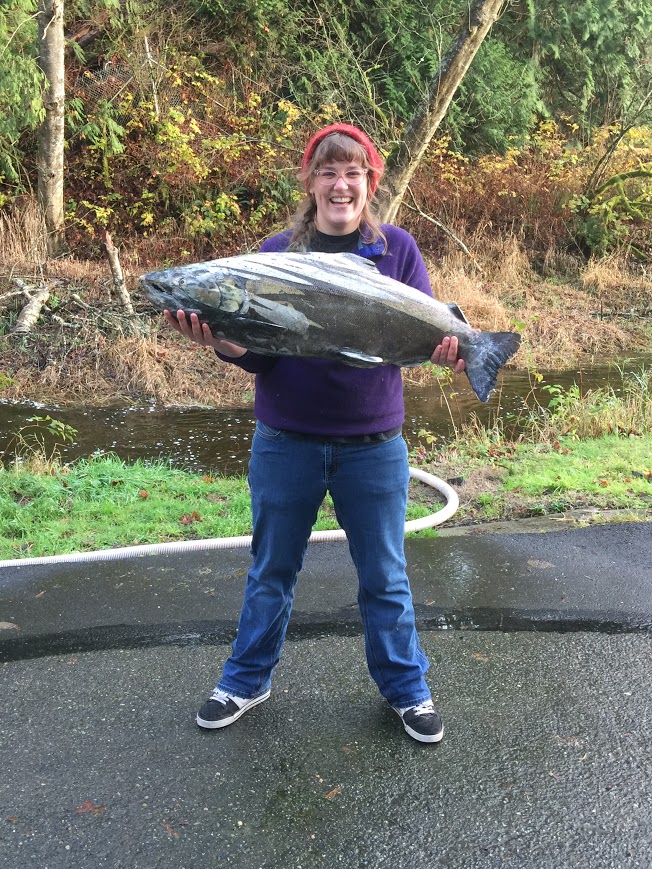
Nora Hickey is a veterinarian working at the Northwest Indian Fisheries Commission.
1. What is your current research/position?
My
current position is Program Veterinarian at the Northwest Indian Fisheries
Commission. I work along with three AFS-FHS certified Fish Pathologists to
provide fish health services for wild and hatchery Pacific salmon in the care
of twenty treaty tribes in Western Washington. I started this position last
year after graduating from vet school. This June I will have been in the
position for one year.
2. What sparked your interest in aquatic animal
health?
Aquatic
animal health was a way to combine fish with medicine. I’ve always kept
aquariums, and during my undergrad at MIT I volunteered at the New England
Aquarium in the Freshwater Gallery with Scott Dowd of Project Piaba, which was
incredibly awesome. A lot of my friends from MIT were going the pre-med route
to become human doctors, which seemed like a very interesting career. When I
discovered vets working with fish at the New England Aquarium and in zebrafish
labs at MIT, I decided to become a fish vet.
3. What has been your favorite fisheries-related
job?
Anything with field work. When I was in college, I
spent four summers working for the University of Wisconsin-Madison Center for
Limnology on the fish crew sampling lakes for a long term ecological research project.
This involved activities like electrofishing for giant muskies and wrestling
rogue snapping turtles out of fyke nets. It was very fun, especially
considering how terrible I am at fishing—I could never have caught any of those
fish on my own.
4. How did you find your current position?
My
current position was advertised on a variety of mailing lists for aquatic
animal health professionals. I wasn’t sure about applying for it because it was
advertised in September, and I wasn’t graduating until May of the following
year, but fortunately my mentor encouraged me to apply.
AFS-FHS
and other organizations have mailing lists where fish health positions are
regularly advertised, and I think it is really important to start reading
position advertisements early on in your education, even if you aren’t ready to
apply for jobs yet. I monitored job advertisements throughout vet school to get
an idea of what the average fish veterinary position looked like—salary, required
qualifications, responsibilities, hours (including after-hours expectations), and
progression—so I could have a better idea of what I wanted when I started
applying for jobs.
5. What do you
like about your current position?
I really
enjoy working for the tribes because they are incredibly committed to
protecting both the salmon and the ecosystems they live in.
Clinical
work is my favorite part of my current position. Spending a day at a hatchery looking
at fish and working with the hatchery staff to figure out strategies to improve
fish health is very rewarding. I usually spend several days a week in the field
doing clinical work, often more—spawning season is my favorite!
6. When and why did you first become involved with
AFS and the FHS?
I
joined AFS and the FHS last summer right after I started my job. This past
April I attended the AFS-FHS meeting in East Lansing, which I found very useful.
The meeting was a good opportunity to see how different regions and agencies
are approaching fish health. The talks were incredibly diverse, covering topics
from vaccination and disease transmission to coral diseases to laboratory
methods to determine antimicrobial resistance—but I was able to take away
information from each of these talks that was applicable to my own work with
the health of salmon in the Pacific Northwest.
7. What are your long-term professional goals (FHS or otherwise)?I was fortunate to have an excellent mentor in Dr. Myron Kebus, who helped me get the experience and knowledge I needed to secure a position as a fish vet. There are many vet students who are interested in fish medicine, but it can be difficult for them to get access to experiences with fish veterinarians for a variety of reasons—difficulty establishing contacts in the field, a shortage of formal externship opportunities, and competition for educational opportunities to name several. I would like to collaborate with other fish health professionals to make a more accessible path for vet students to gain knowledge and experience in fish health. This is something that Doug Munson with Idaho Department of Fish and Game has been working very hard on for several years, and I am hoping to collaborate with him on this project.
8. Do you have any tips or advice for others that may be looking for a job soon?Shadow people who have the job you want. This will give you specific experience and knowledge that shows you are serious about that particular position. While you are shadowing, pay attention to how the person you are following actually spends their time—and make sure that this aligns with how you imagined the job. I think that liking your job is at least as important as salary, work hours, benefits, etc